Computer Vision
AI tasks involving images, videos, and spatial understanding
Computer vision enables machines to interpret and understand visual information from the world. These tasks range from simple classification to complex scene understanding, powering applications in autonomous vehicles, medical imaging, robotics, and creative tools.
Classification Tasks
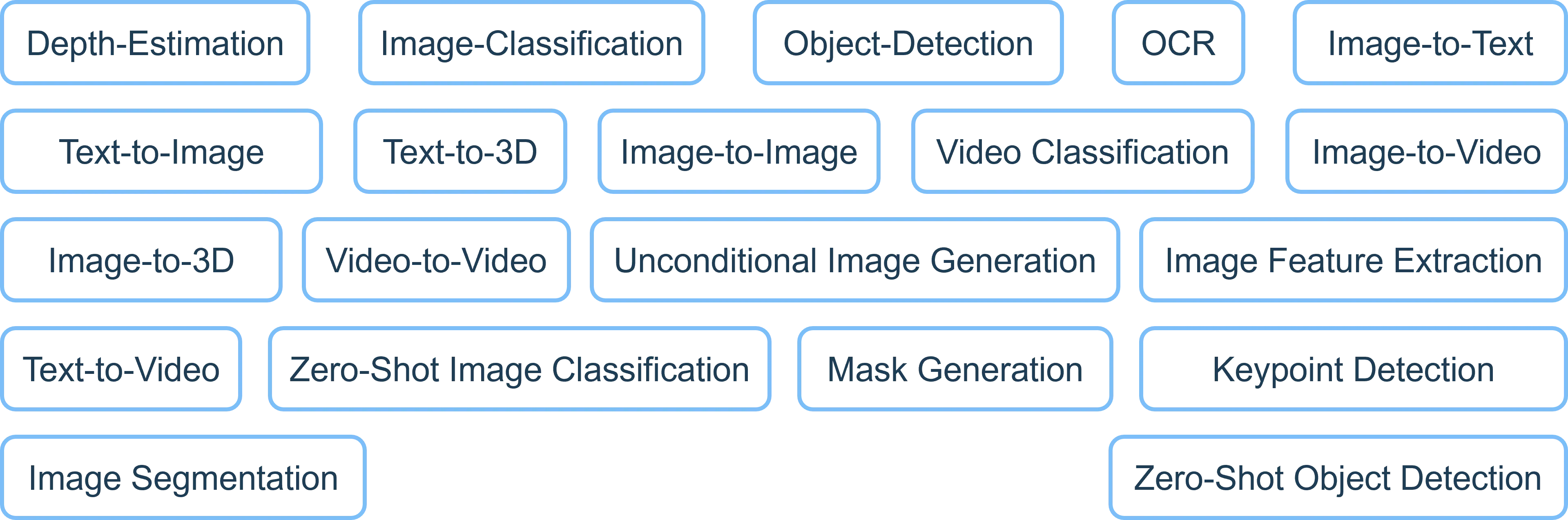
- Image Classification: Assign labels or categories to entire images based on their content
- Video Classification: Classify actions or scenes in video content
- Zero-Shot Image Classification: Classify images into categories never seen during training
Detection and Localization
- Object Detection: Detect and localize multiple objects within images using bounding boxes
- Zero-Shot Object Detection: Localize unseen object categories without training
- Keypoint Detection: Detect specific points of interest such as joints, landmarks, and structural features
Segmentation
- Image Segmentation: Pixel-level labeling for object boundaries and regions
- Mask Generation: Generate segmentation masks automatically
Generation Tasks
- Text-to-Image: Generate images from text prompts
- Text-to-Video: Generate videos from text descriptions
- Image-to-Image: Modify or restyle images using another image or prompt
- Image-to-Video: Generate videos based on input images
- Video-to-Video: Transform or modify video content
- Unconditional Image Generation: Generate images without any prompt or condition
3D Tasks
- Text-to-3D: Generate 3D models from text descriptions
- Image-to-3D: Reconstruct 3D shapes from images
Other Vision Tasks
- Depth Estimation: Predict a per-pixel depth map from images to understand 3D scene structure
- Image-to-Text: Convert images into natural language descriptions
- Image Feature Extraction: Generate embeddings or semantic features from images
- OCR: Extract text from images and documents
Getting Started
Computer vision tasks typically require:
- Quality training data: Properly labeled images or videos
- Computational resources: GPUs are essential for training and inference
- Appropriate architectures: CNNs, Vision Transformers, or specialized models
- Evaluation metrics: Task-specific metrics to measure performance
For training custom models, explore our training documentation for detailed guides on available architectures and parameters.